

Final thoughts
'You have to know where you came from to appreciate where you're going to', a certain Boris Becker mused when talking about the traditions of Wimbledon, today.Looking back just over a year, ATI's weak response to the all-conquering G80 was the Radeon HD 2900 XT (R600) GPU. Impressive throughput numbers hid the inelegance of the architecture. Yes, it was good on paper, but, at the time, six-month-old GeForce 8800 GTX and nascent 8800 Ultra brushed it aside with consummate ease. ATI was playing catch-up, big style.
Moving on another six months, to November 2007, ATI released the Radeon HD 3870, a product that liberally cleaned up the R600 architecture, added a number of performance- and power-related tweaks, and retailed at around £150. No GeForce 8800 Ultra-beater, sure, but it made ATI focus on attempting to win the mid-range battle. The HD 3870 enjoyed an on-paper specification advantage against the GeForce 8800 GT and GTS SKUs but that petered out in benchmarks, where it oftentimes lagged behind.
Moving on to last week and ATI's mid-to-high-end catalogue consisted of the £89 HD 3870 and £239 Radeon HD 3870 X2. NVIDIA mopped up in-between, primarily with SKU based on the venerable G80. The top-end was sown-up by the somewhat brutish, inelegant GeForce GTX 280, providing, on average, 50 per cent more performance than any previous single-GPU design.
ATI's next-generation GPUs needed to ramp the performance quotient whilst maintaining excellent value-for-money: a tricky task at the very best of times.
Now, when news filtered through regarding Radeon HD 4850 and HD 4870 (RV770, collectively) we raised the right eyebrow. After all, Radeon HD 4870 really is significantly better than HD 3870 in almost every way - it enjoys a 242 per cent increase in arithmetic processing (shading) and bilinear/FP16-type texturing, and a 158 per cent gain in memory bandwidth. There are other behind-the-scenes advances that make it even faster, too.
Radeon HD 4850, too, is no slouch, beating out HD 3870 by 202 per cent for shading/texturing but losing out by around 10 per cent in terms of theoretical memory bandwidth, although ATI-stated optimisations probably erode that to, well, nothing.
If our right eyebrow was already raised, the left one joined it as soon as we learned of the price: $199 (£125, once rip-off Britain is factored in) for the HD 4850 and $299 (£175) for the HD 4870. The reason why ATI and its partners can make pricing so aggressive lies with the die size, or lack thereof, with RV770 - it's only 35 per cent larger than HD 3870's, mainly brought about by shrinking the SIMD arrays and texture units and, of course, by keeping the slimline 256-bit memory interface.
If GPUs were evaluated solely via on-paper specifications - which, thankfully, they're not- ATI's new mid-range and enthusiast-class GPUs would have beaten NVIDIA current offerings to a small pulp. Bish, bash, bosh! Take another look at the table on page four for confirmation. However, once we factor in NVIDIA apparently seamless developer-relations support that really does get the most out of the architecture, the new Radeons' dominance wanes somewhat. What should have been a massacre turns into a honest-to-goodness slugfest, and that's only made possible by NVIDIA chopping the prices of its key mid-range GPUs.
Thinking of in-game physics, NVIDIA's purchase of Ageia has yet to reach full fruition with PhysX-enabled games (UT3 notwithstanding) and ATI nascent tie-up with Havok will be felt in Q4 2008, we feel. Both show impressive performance but NVIDIA's definitely got the advantage here.
Let's take each of the Radeon HD 4800-series cards and come to some kind of conclusion.
Radeon HD 4850 512MiB
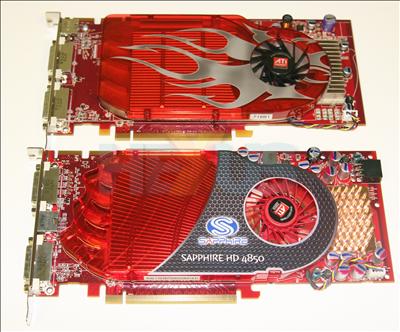
The £125 Radeon HD 4850 - clocking in at 625MHz core and shader, and 2,000MHz GDDR3 memory - opens up a can of whoop-ass on the Radeon HD 3870; it has more of everything. Looking at our mid-range results, it does a pretty good job on beating up on other supposedly mid-range cards. Indeed, only the GeForce 9800 GTX, priced at £175 today but mooted to drop to £125 soon, offers real resistance.
In fact, so potent is the dizzying combination of performance and price, that we enter it into our high-end setup, running against GPUs costing considerably more.
The performance numbers show that it delivers a little less than the dual-GPU Radeon HD 3870 X2 and around the same levels as the GeForce 9800 GTX. You can see exactly why NVIDIA's reduced the pricing of that SKU to an estimated £125, because it becomes an untenable proposition any higher. Ignore the NVIDIA spin and concentrate on the fact that ATI's new introduction has caused NVIDIA to wet the pricing bed with aplomb.
Muddying buying advice further is the soon-to-be-introduced GeForce 9800 GTX+ - a 55nm-based GPU that ships with higher core and shader speeds than the regular GTX. Due mid-July with a street price of $229 (£150, probably), our tests show it to be a little faster than the Radeon HD 4850. We reckon that partner-overclocked HD 4850s will fight against it, and that's for another day.
CrossFire performance is a little lower than twin GeForce 9800 GTXs, though, and that's something that ATI needs to continue working upon.
Taking all this into account, and bearing in mind the multimedia upgrade, single-slot cooler and DX10.1 compatibility, the Radeon HD 4850 becomes our choice of GPU at £125, even if NVIDIA partners' pricing for the GeForce 9800 GTX drops to the same levels. Why? Because it's so much more elegant in almost every way.
Radeon HD 4870 512MiB
The bigger brother is the HD 4870. Faster core and shader clocks - 750MHz - are allied to mind-numbingly faster memory, operating at an effective 3.6GHz and facilitated by new-fangled GDDR5. The memory-speed lets the architecture breath, to the extent that it's around 25 per cent faster than the HD 4850.
Performance is such that it sits between GeForce 9800 GTX+ and, most likely, GeForce GTX 260. The shipping price of $299 (£175) means that it has no direct single-GPU competitor from NVIDIA, so if you've got £175 to spend, we'd look towards recommending it.
CrossFire performance scales incredibly well in some games but is lacking in others; that's the pitfall of dual-GPU rendering, we're afraid.
NVIDIA still retains the overall performance crown, comfortably, with GeForce GTX 280, but that's not batting in Value Park, is it?
Overall
ATI's introduction of the Radeon HD 4800-series GPUs has upset the status quo in no uncertain fashion. Blistering compute power and incredible memory bandwidth from a 256-bit bus means that small-die RV770s are fundamentally better than the Radeon HD 3800-series they replace.
Looking towards the competition, the only way that NVIDIA's been able to compete against the salvo of keen pricing and the Radeon HD 48x0's efficient, powerful architecture is to reduce prices across the board- and that incredibly telling in itself.
Bottom line: we'd be happy to recommend the Radeon HD 4850 at the £125 mark; it's a fundamentally better design than the 18-month-old technology of the GeForce 9800 GTX and, even with the new pricing factored in, makes for a better all-round performer. The Radeon HD 4870 extracts the most out of the architecture through, in the main, super-fast memory, and we'd give it a tentative recommendation, waiting to see just how partners employ the GeForce 9800 GTX+
ATI's back in a big, big way in the sub-$300 space. NVIDIA, apart from price-chopping, what's new, huh?
Then, of course, there's the twin-GPU R700, as well. Just take a look at HD 4870 CrossFire performance and you'll appreciate where it will sit in the pecking order.
HEXUS Awards
The Sapphire Radeon HD 4850 receives the HEXUS Gaming Recommended award for combining an excellent architecture to a surprisingly low price. It's our best buy for ~£125.
Sapphire Radeon HD 4850

Sapphire Radeon HD 4870
HEXUS Where2Buy
Radeon HD4850 range - Scan.co.ukSapphire Radeon HD 4870 pricing TBC.
HEXUS Right2Reply
At HEXUS.net, we invite the companies whose products we test to comment on our articles. If Sapphire or ATI (AMD) chooses to respond, we'll publish its commentary here verbatim.HEXUS related reading
HEXUS.net- HEXUS.reviews
:: BFG
(NVIDIA) GeForce GTX 280: does it rock our world?
HEXUS.net- HEXUS.reviews
:: NVIDIA
(BFG) GeForce 9800 GTX. Got £200 for a graphics card? Read
this
HEXUS.net - HEXUS.reviews
:: MSI
vs. ZOTAC: shootout at the GeForce 8800 GTS 512 Corral
HEXUS.net - HEXUS.reviews
:: ATI
Radeon HD 3870
HEXUS.net - HEXUS.reviews
:: ATI
Radeon HD 3870 X2
HEXUS.net - HEXUS.reviews
:: NVIDIA
(ZOTAC) GeForce 9800 GX2 - the champ is back!
HEXUS.net - HEXUS.reviews
:: ASUS
vs ASUS: GeForce 8800 Ultra vs Radeon HD 2900 XT
HEXUS.net - HEXUS.reviews
:: NVIDIA
GeForce 8800 Ultra 768MiB