Intee
It's
a well-known fact that Intel isn't going to derivate the current
Nehalem CPU architecture down to mid-range chips featuring dual
processing cores.
The mainstay of the 45nm process is the Lynnfield quad-core
architecture, released in September, and destined to run through 2010.
The current dual-core chips are based on the Core 2 design, and
they will be replaced by the Clarkdale (desktop) and Arrandale (mobile)
cores that are hewn from the upcoming 32nm Westmere architecture.
Aside from using the latest process technology, the new chips will
feature integrated graphics on the same package as the CPU.
Looking at it at a high-level, Clarkdale, then, is a 32nm dual-core,
four-threaded
(hyperthreaded) chip
that's internally QPI-connected to separate piece of 45nm silicon that
houses the
GPU and dual-channel memory-controller - in the same package.
Due to be launched in Q1
2010, and branded under the Core i3/i5 banner, the fastest Clarkdale chip
will clock in at 3.46GHz. Good enough to worry AMD, no doubt, but how
high will the new process go using basic air cooling?
The folks over at lab501.ro have managed to snag an engineering-sample
Core i5-650, attached a big-ass Noctua NH-U12P cooler, and cranked it
all the way up to 4.7GHz.
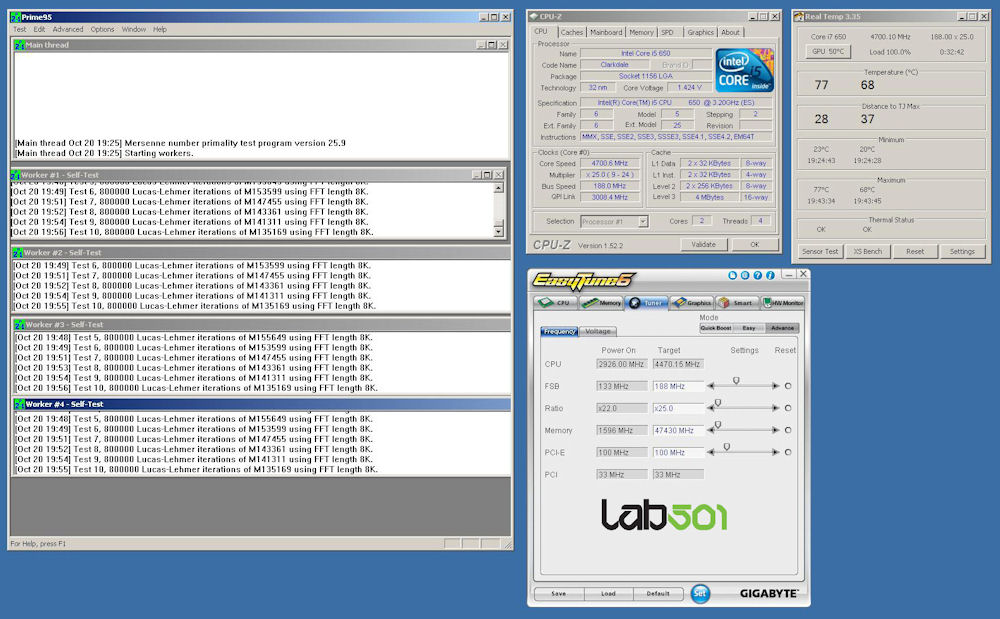
Picture courtesy of lab501.ro (click to enlarge)
Stable for 30m under Prime95 load, the 32nm process appears to have
plenty of headroom. Worrying for AMD, the integrated graphics are
significantly
better than anything Intel has
produced thus far, so 2010
may well prove to be a difficult year from the CPU perspective.
We're very keen to see what price Intel attaches to
Clarkdale chips and
what AMD does to respond. Should the recent
price-adjustment
exercise be anything to go by, we'll be seeing a greater number of
quad-core chips at under £100.

HEXUS related reading
HEXUS.net -
press releases ::
Intel® Itanium® 9300 Processor Raises Bar for Scalable, Resilient Mission-Critical Computing
HEXUS.channel -
news ::
Intel finally launches new Itanium
HEXUS.channel -
news ::
Intel unveils vPro 2010
HEXUS.net -
news ::
Intel's hexa-core Gulftown processor on course to debut on March 16th?
HEXUS.channel -
press releases ::
Intel, Micron Introduce 25-Nanometer NAND – The Smallest, Most Advanced Process Technology in the Semiconductor Industry
HEXUS.net -
news ::
AMD bolsters budget CPU line with new Phenom and Athlon additions
HEXUS.net -
news ::
Intel to release 32nm Westmere-based Xeons within three months
HEXUS.net -
press releases ::
GLOBALFOUNDRIES Finalizes Integration, Emerges as World’s First Truly Global Foundry
HEXUS.net -
press releases ::
NVIDIA today launched its Next Generation Tegra, the world’s first processor for the mobile web, specifically designed for the high-resolution needs of tablets.
HEXUS.net -
press releases ::
Intel Unveils All New 2010 Intel® Core™ Processor FamilyAll Intel related content on HEXUS
HEXUS.community :: your right2reply
lets see it do the recommended 8hours prime stable anyone after a fully stable OC would go for ;)Quote
30minutes prime stable - pfffffft
lets see it do the recommended 8hours prime stable anyone after a fully stable OC would go for ;)
I would like to see it Linpack stable too!!
There is no point getting excited over the overclocking ability of both AMD and Intel engineering samples!! ;)
Also we have not got a clue what the safe operating voltage of the 32nm processors is as 1.4v seems a tad high. IIRC the early 45nm Core2 processors were not very tolerant of voltages above 1.5v for very long.Quote
Mildy interesting... so am I right in thinking Moore's Law is now failing as we are not seeing that doubling of power any more (well maybe double TDP in recent years!)
no, moores law is about transistor count on a die, rather than clock speed. in terms of clock speed, bear in mind there was a 3ghz p4 released a good 7/8 years ago. after 3-4ghz temperatures escalate too rapidly.Quote
Reply