

The absolute need for speed is paramount for the enthusiast community.
Nowhere is the drive for higher frequencies more visible than in the memory market. What's more, with system-based memory an order of magnitude slower than on-CPU cache, having more readily-available bandwidth is always good.
The state of play at the beginning of 2007 was defined as one where leading exponents of enthusiast-oriented memory were approaching the performance envelope of DDR2. Corsair, for example, managed to speedbin select DDR2 memories at an effective 1250MHz (PC10000) and whilst we may see limited-run SKUs go even higher, DDR2's frequency headroom and days are numbered.
The next evolution in SDRAM is, matter of factly, DDR3. We've already seen Intel debut it with its Bearlake series of chipsets and, sooner rather than later, all major chipset design teams will follow suit. DDR3, then, is a natural progression in sating the need for ultra-high frequencies and bandwidth.
We'll list the major advances that DDR3 gains over DDR2 and how they'll impact upon performance.
Frequency scaling - Corsair reckons that DDR3 will scale from an effective 1066MHz - which is considered high-end for current DDR2 - to over 1600MHz in the coming months.
Lower voltage/smaller manufacturing process - One reason that DDR3 will scale higher is due to a manufacturing process shrink to, in the main, 90nm, allowing for faster switching and lower voltages. DDR3 will run off 1.5V, compared to DDR2's 1.8V. Voltage reduction can be viewed in two ways. Firstly, for the same given voltage - 1.8V - DDR3 should clock significantly higher. Secondly, in cases where power draw is critical (laptops, for example), DDR3's smaller power footprint will aid battery life.
Dynamic on-die termination/differential data strobe - Both of these features are designed to keep the signal path as clean as possible during high-speed transfers. ODT, also available with DDR2, aims to terminate reflective signals from impacting upon signal integrity, but with DDR3 it's dynamic such that the impedance can be varied between two (preset) values.
8-bit prefetch - DDR can prefetch 8 bits (words) for every read/write cycle and push them to the output buffers, compared to DDR2's 4. This is what gives DDR3 its main (doubling) speed advantages, with the actual core at the same speed as DDR2's. This is also why DDR3 has a native burst length of 8, with a burst chop of 4, where the remaining 4 are masked.
240-pin modules - Modules will keep the 240 pins mandated by DDR2 but will have the notch in a different location, to ensure that DDR2/3 modules aren't DIMM slot-compatible.
Other gubbins - DDR3 also features a master reset function that will allow the SDRAM to be properly reset to a known state should problems arise. Further, DDR3 also has the capability to auto-refresh and adds in more-efficient pinouts, too. Summing it up, then:
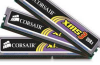
Corsair announces DDR3 modules

Corsair has formally announced a range of XMS3 modules to complement, initially, Intel's Bearlake chipsets.
The TWIN3X2048-1066C7 is a 2GiB pack of matched memory that operates at an effective 1066MHz with 7-7-7-21 timings, representing JEDEC-approved values. The TWIN3X2048-1333C9DHX sports even-faster speeds of - wait for it - 1333MHz with 9-9-9-27 timings. We expect to see retail Bearlake motherboards offer this native memory speed with upcoming 1333MHz FSB CPUs.
It's common to see newly-introduced DDR3 with high latencies, just as we did with the introduction of DDR2.
How much slower is the same-speed DDR3 when compared to DDR2? We'll find out when we take a look at ASUS P5K3 Deluxe WiFi motherboard.
Get used to DDR3: it's not a fad that's going away.