

HEXUS.lifestyle editor Bob Crabtree puts aside his green-tinted eyeshades and goes green all over to applaud VIA's attempts to promote the use of low-energy computers, even as he criticises the choice of wording and the confusion that may result.
The Royal Botanic Gardens, Kew, was the highly-appropriate setting yesterday for a media event promoting VIA's world-wide computing initiative to reduce carbon dioxide (CO2) emissions.
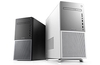
At the event, two UK-produced low-energy PCs were introduced. One, the Carbon 3, is from Evesham Technology and due in the coming months; the other, actually a range of models, is from quiet-system-specialist Tranquil PC and has been available for a little while.
Rather less appropriately, both PCs, like the initiative, carry the confusing and virtually meaningless label, "Carbon Free".
From that, it's all too easy to infer that VIA and its partners have cut out all the carbon within PCs - as though carbon were somehow an environmental poison, like lead or cadmium, which, of course, it's not.
What VIA is actually doing is making an effort to tackle one significant cause of global warming - the excessive energy used by personal computers. In addition, it's running various environment-improvement schemes, most notably tree-planting, some of which are only at very early stages.
The thinking about trees is that, as they photosynthesise, they take in CO2 and give off oxygen.
VIA's idea, more or less, is to plant sufficient trees for each processor to cancel out the CO2 that would be created by the production of the electricity required to run that CPU for its useful life. Perhaps a little surprisingly, though, that life VIA estimates as being only three years.
The same strategy of using trees and other environment-improvement schemes as CO2-offsets is being applied by VIA to motherboard chipsets and graphic processors. It's also integral to the certification of Evesham and Tranquil PCs as being Carbon Free computers - a process that VIA, rather than any independent body, carries out.
There are, of course, commercial reasons for VIA's apparent altruism and for its tree-huggin. The company specialises in making CPUs and chippery with far lower power consumption than its competitors' products. Consequently, telling the world about it should boost sales.
That boost might be doubly helpful given that these low-power parts can have a practical downside that leaves VIA at a commercial disadvantage. As most HEXUS readers will be more than aware, VIA's products are often out-performed by competitors' more power-hungry parts.
This performance disadvantage may not be noticeable or relevant in the every-day use of PCs for office and internet applications but it's likely to be holding back sales in some sectors - with no valid reason.
A business, organisation or government department running lots of PCs - whether 100, 1,000 or 100,000 - can instantly see the economic returns of switching to lower-powered machines.
For home users with just one or two PCs, the saving is not so great and the need less obvious.
But even if these home users never require the grunt that more power-hungry machines can deliver, they'll find that hard to believe all the while they're loudly - and frequently - being, in effect, told otherwise by the many companies aiming to sell them the latest and greatest (and in many cases quite unnecessary) speed-demon, power-hungry PCs.
The very fact that VIA is pushing the advantages of its own technology - technology that could be described as technically inferior - may lead cynics to say that it is only using environmental issues for self-promotion, profit and as a cover-up.
That's going to leave the company open to criticism - principally by competitors who may feel duty-bound to take a sceptical stance. Such competitors are also well placed - and possibly sufficiently motivated - to undermine Carbon Free by claiming that it is an attempt to mislead buyers.
They and other cynics will be able to point out that VIA gives no consideration at all to one very relevant and massive cause of CO2 production with PCs - the energy used in manufacturing CPUs, chipsets and all the other many components, active and passive.
And at this early stage, VIA isn't doing much to help itself. When the subject was raised at its Kew briefing, the company rather reluctantly admitted that it did, indeed, need to factor manufacturing into the equation if it is to tell a more complete and accurate environmental story - and then it had to concede that this is something that's not going to be happening in the near future.
Competitors who chose to carp about VIA's lack of totally joined-up thinking, though, do leave themselves open to criticism that the energy consumed by their own production methods also leads to excessive emissions of CO2.
Even so, that danger still might not prevent them from claiming that Carbon Free isn't just confusing and misleading but verging on the fraudulent.
We take a very different position even while accepting that VIA is primarily pushing the benefits of its own technology and hasn't thought things through quite as well as we'd have hoped.
We'd point out that the same apparently self-serving use of environmental issues could be used as a stick to beat makers of wind-farm equipment, solar-energy panels and a whole swathe of other environment-enhancing products.
Rather more significantly, the same is true for many manufacturers outside the fields of computing and environmental protection but still, in our view, isn't necessarily cause for criticism.
Fridge makers, for instance, have completely eliminated the use of CFCs and also greatly reduced the power consumption of their big white boxes. Dishwasher makers - often the same companies, it's true - now turn out machines that use less detergent, energy and water than even before.
Similarly, there are carmakers who strive to produce vehicles with very low fuel consumption or that are powered by alternatives to petrol and diesel. Many other types of company also seek to benefit from taking the lead in the development of products that are environmentally-friendly or, at least, less harmful than they would otherwise be.
Some of these changes may have been driven by legislation - actual or impending - and, often, we've had Germany to thank for much of the pressure that's been applied.
But the firms that are first to implement these changes do tend to grow taller in the eyes of consumer who are aware of environmental issues and, maybe more importantly, in the eyes of some big institutional investors, such as pension funds, whose remit is to operate in ethical ways.
More important than either is that these changes benefit us all.
VIA could also be criticised for promoting CO2-offsets. After all, it is going to be far cheaper for VIA to implement such schemes than for competitors because, typically, the competitors' CPUs, chippery and GPUs use far more electricity and would require far larger offsets.
But that is the very point that must be borne in mind - competitors' products do use far more electricity.
And that means they cause the emission of far more CO2!
We believe that what VIA is doing should be welcomed, despite any and all shortcoming of the Carbon Free banner and the fact that the manufacturing side is not yet integral to the story it's trying to tell about environmental impact.
The company has come up with a very worthwhile way of publicising the need to reduce the energy used by computers across the world.
That, hopefully, will not be ridiculed by the media, nor cause competitors to pour scorn.
Instead, we hope that all of VIA's rivals react responsibly by looking closely at the energy consumption of their products and trying to reduce it as far as possible.
And remember - as if you could forget - that a whole mass of evidence points to the fact that excessive emissions of carbon dioxide have caused and continue to cause global warming, with much of the CO2 the result of fossil fuels burnt to generate electricity.
This warming is leading to profound climate changes that are thought likely to have already produced a significant increase in environmental disasters, such as flooding and landslides in some places and droughts in others.
But far more catastrophic consequences for the planet we all live on are being forecast if we don't rapidly and significantly reduce CO2 emissions worldwide. Some may happen in our lifetimes but others, more certainly, will take place in our children's.
We don't expect you or anyone else to look at what VIA's doing through rose-tinted spectacles - there are valid criticisms that can and should be made and more of them than we've highlighted.
But we would hope that you'd take seriously the excessive power consumption of PCs and stand up to debate the issues with cynics and any self-servers who unreasonably dismiss VIA's initiatives.
We'd really like to think that your doing so may not even be necessary, although that would mean VIA's competitors had reacted in a positive way that benefits the planet. That, however, would have required them to come to the realisation that such a reaction is appropriate for a sound business reason - it's the one most likely to maximise the long-term return to their shareholders.
Reasonable or rubbish? Check out VIA's own press release and investigate the key links that tell you more about its initiative, then share your thoughts with us in this thread in the HEXUS.news forum.
HEXUS.links
HEXUS.community :: discussion thread about this articleHEXUS.pressreleases :: VIA and UK System Partners Launch World's First Carbon Free Personal Computers
External.links
Evesham Technology - home pageTranquil PC - buying page