Published: Thu 18th Mar, 2010 | Author: Parm Mann
Companies: AMD (All AMD content)
Intel has already kicked off a generation of hexa-core computing with its wicked-fast Core i7 980X processor, but for those who don't have the best part of a grand to spare, you might be waiting for the cheaper, less-potent AMD alternative.
Thought to be arriving next month, AMD's first six-core CPUs will arrive in the form of Phenom II X6 parts codenamed Thuban.
Whilst we know they're en route, and likely to be a whole lot cheaper than Intel's first six-core part, we haven't yet had a clear indication of clock speeds - until now. Jumping the gun, motherboard manufacturer GIGABYTE temporarily updated its CPU Support List with two new additions; the Phenom II X6 1055T and Phenom II X6 1035T.
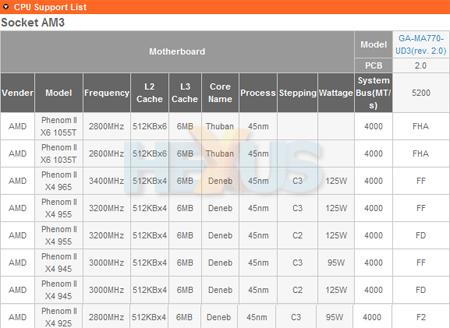
GIGABYTE has since pulled the listing, but AMD's yet-to-be-announced parts have been revealed to be clocked in at 2.8GHz and 2.6GHz, respectively, and despite featuring a total of six physical cores, will be built on the same 45nm process and come equipped with 6MB of L3 cache and 512KB of L2 per core.
There's no mention of a TDP for AMD's upcoming parts, unfortunately, but recent rumours have suggested that both the Phenom II X6 1055T and Phenom II X6 1035T will come in at 95W. Sounds reasonable, considering the seemingly-conservative clock speeds.
Conjecturing somewhat, the rumour mill has also hinted at a 3GHz hexa-core part dubbed the Phenom II X6 1075T. It's said to feature a 125W TDP, and should be arriving late April.
The good news is that all of AMD's Thuban processors are backward compatible with socket AM3. If you're looking to get in on the world of hexa-core computing, one of the above-mentioned CPUs is certainly going to be the cheapest route.

Copyright © 1998 - 2010, HEXUS.net. All rights reserved. Terms, conditions and privacy information.
HEXUS® is a registered trademark of HEXUS Limited.

HEXUS.community :: your right2reply
I'm run chemistry simulations for a living - I crave clock efficiency and fast memory. This is what i7 offers, with its high throughput per clock and triple channel memory. Thuban offers 6 physical cores, whereas i7 has 4 physical + 4 logical, where the logical have a high attrition rate and offer near as damnit 8 core performance. Combine that with triple channel DDR3 for i7 vs dual channel DDR3 for Thuban and it's a nobrainer.
At maximum an SMT core is worth 30% of a real core so you get 5.2 cores compared to 6 for Thuban best case, it's nowhere near 8 cores.
Thuban will trounce any quad i7 in rendering and encoding for sure. You seem to have missed the news that Thuban has it's own turbo mode btw. :)Quote
At maximum an SMT core is worth 30% of a real core so you get 5.2 cores compared to 6 for Thuban best case, it's nowhere near 8 cores.
Thuban will trounce any quad i7 in rendering and encoding for sure. You seem to have missed the news that Thuban has it's own turbo mode btw. :)
Good to hear about Turbo mode for Thuban.
Although I was under the impression that while not particularly close to 8 cores, it was significantly more than 130% of 4 cores. I reserve judgement on how Thuban compares to quad i7 for reviews - I hope Thuban performs favourably, but I have my doubts.Quote
Thuban is still K10 based logic, i.e. that of the Phenom II X4s. So essentially it's another 50% of cores built on top of a Phenom II X4. That still makes it far behind in single thread, and just behind the i7 in MT.
I do however agree that the Thuban will take the price/performance crown, but it's not the performance crown - the halo product. They need an architecture change to increase single thread performance to get it.Quote
On *both* sides.
I am interested in this turbo mode for thuban though.Quote
Reply