Published: Monday 9th November, 2009 | Author: Sylvie Barak
Companies: AMD (All AMD content)
According to AMD, your television is about to become obsolete. Jonathan Seckler, AMD's senior manager for product marketing, reckons visual experiences on a PC will soon surpass those of the living-room television as people become increasingly mobile.
"TV is a fad," declared Seckler controversially, adding "the end of television can be seen." [Er, yes, tune in this time next week to watch the final episode, folks]
"Entertainment has become much more mobile," said Seckler, adding that the institution of television "as a passive medium where we all sit around like couch potatoes is coming towards the end."
Seckler said AMD's new Vision branding would pave the way to making mobile entertainment more tenable, especially on mainstream platforms like Tigris. AMD also has technologies such as AMD Theatre, which lets users tune into local stations from their laptops.
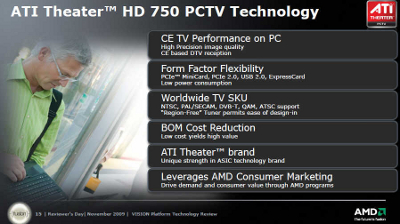
"We have platforms that are actually tailored to usage models," he declared, referring to how much time Americans spend watching television shows online on services like the currently free, but not for long, Hulu.
AMD's vision of the end of TV times may be a little premature, however. Back at Intel's developer forum in September, the bigger chipper declared it would actually be pushing its hugely popular Atom chips into set-top boxes and televisions, to bring a little more interactivity to what it described as "the hub of the home."
Likewise, in a recent chat with Intel's anthropologist Genevieve Bell, HEXUS was also told that Intel was adamant that any attempts to add Internet functionality to TVs needed to be simple and not interfere with the experiences and behaviour patterns viewers enjoy, because people still held a very strong bond to the big box in the living room.

Copyright © 1998 - 2010, HEXUS.net. All rights reserved. Terms, conditions and privacy information.
HEXUS® is a registered trademark of HEXUS Limited.
HEXUS.community :: your right2reply
The cost of everyone moving to streaming TV would be massive. Nothing about hardware, the bandwidth costs would be phenomenal.
There has been a lot of fuss about the move to digital from analogue, can you even imagine the upheaval and controversy of moving to an internet streaming model? Requiring a phone line, with decent enough ADSL connection, exchanges that aren't going to get swamped, etc. Set top boxes are going to be a lot more expensive than a basic DVB-T box that can be produced in their millions in China, they will be little PCs after all.
Perhaps one day, but I think it will be a long way off.Quote
TV Tuner cards? They are not the answer imo - streaming makes a lot more sense, and imo tuner cards are likely to vanish before TVs do. They may however be replaced by dedicated decoder cards for future HD codecs and technologies..or simple CAM modules for subscriptions.
I don't think they will, I just think the nature of television will change. Consider that if 64 million people stream television content through their computers in HD, how many bandwidth will that need?
But alternatively, if that single stream can distributed once, and accessed at will... well that's a whole different story. I think the on-demand functions will combine with the live streaming functions to give you more flexiablity, particularly as bandwidth becomes more a concern.
Let me theroise for this, there is a mass content release system, for the purposes of this experiment we will call this the wire. It's a wireless transmission and wire cable transmission that has all the latest content being released in the form of digital transmissions. You can download content directly off the wire, but content will only be released to the wire once. None of this repeats we get now.
If you miss the wire because you didn't know about the program and were introduced to it, or other reasons like powerfailure, you can make an ad-hoc request for that content.
Why will this model be important? Well, some of the things that make television as we know it what it is, and are unlikely to go away, are call in compeititions like X-Factor, interactive content. How can we telly the votes in such a way that we can have such a short turn over if all the content is streamed? We we have a central stream, or "off the wire", which is the "live" broadcast.
There is another reason, and I touched on it before. And that is bandwidth. Now let's take a new program that is released with 2.2 million views, just as a conservative estimate. Assume they are all watching it in 720p, (some may watch it in SD because of bandwidth limitations, others in 1080i because they have ultra-wide-band contections, but 720p is a good average). 720p content is typically about 420kiB/s of bandwidth per stream. Now that means that in order to distribute that content, and for people to get it live, or the equivelent of getting it "off the wire", the BBC, or whomever is distrbuting it, will need to be able to provide bandwidth of about 0.86 TiB/s. And that is just for that one program.
Now althrough this is techically possible to deliver, it is expensive. It is much cheaper to distribute the content via UHF transmission in DVB, or something similar i.e. cable, or a single internet stream, than it is to live-stream the content over the internet.Quote
Osama bin Laden declares the death of all, Christ declares no death for any.Quote
And Rollo makes a post without mentioning ATI or Nvidia.
LOL! Zing!
It HAS been a big day for news I guess!Quote
Reply