Published: Monday 20th July, 2009 | Author: Parm Mann
Companies: Crucial Technology (All Crucial Technology content)
When it comes to solid state drives (SSDs), the majority of big-name memory manufacturers - including the likes of Corsair and OCZ - have been eager to adopt the technology, launching quicker models on an almost monthly basis.
It's a surprise, then, to see that Crucial - now merged with Lexar Media as the consumer arm of Micron - is only today rolling up its sleeves and showing its SSD ambition. Although the California-based manufacturer already offers plenty of flash-based products, today marks the arrival of its first high-capacity and high-speed drive - the Crucial M225.
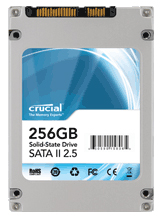
The 2.5in drive is available in 64GB, 128GB and 256GB capacities, and promises to "enhance system performance by improving operating system boot and application load times". All three feature MLC NAND flash memory, and Crucial's flagship 256GB drive (pictured left) promises read and write speeds of up to 250MB/s and 200MB/s, respectively.
The 128GB drive, meanwhile, reads at up to 250MB/s and writes at up to 190MB/s, while the smaller 64GB drive will provide read speeds of up to 200MB/s and write speeds of up to 150MB/s.
Impressive numbers, and the drives - backed by a five-year limited warranty - are available now priced at £104.99, £201.99 and £367.99 in order of capacity.

Copyright © 1998 - 2009, HEXUS.net. All rights reserved. Terms, conditions and privacy information.
HEXUS® is a registered trademark of HEXUS Limited.
HEXUS.community :: your right2reply
http://www.tweaktown.com/reviews/2846/crucial_m225_256gb_solid_state_disk/index.html
looks pretty solid, someone posted the link on ocukQuote
someone needs to make an IDE ssd hard drive there are still loads of IDE laptops out there that will benefit from a SSD moreso than the newer systems released.
I don't agree. Newer systems will benefit far more as they have faster processors, faster and more memory, better chipsets and faster drive controllers.... yet their 2.5" spindle drives probably aren't that much faster than the older IDE ones in the laptops you are speaking about.
So if you put a blindingly fast SSD in an IDE laptop, you wouldn't get the benefit as something else will easily become the bottle kneck. At least a Core2Duo with 4GB RAM and Vista 64bit will jump in performance with an SSD.Quote
I don't agree. Newer systems will benefit far more as they have faster processors, faster and more memory, better chipsets and faster drive controllers.... yet their 2.5" spindle drives probably aren't that much faster than the older IDE ones in the laptops you are speaking about.
So if you put a blindingly fast SSD in an IDE laptop, you wouldn't get the benefit as something else will easily become the bottle kneck. At least a Core2Duo with 4GB RAM and Vista 64bit will jump in performance with an SSD.
Well aside from lower power consumption, robustness and reduced latency? Yes you'll bottleneck in bandwidth but the other reasons as still valid. I have seen IDE drives anyway, and if my old laptops HDD died i'd probably go with one.Quote
Well aside from lower power consumption, robustness and reduced latency? Yes you'll bottleneck in bandwidth but the other reasons as still valid. I have seen IDE drives anyway, and if my old laptops HDD died i'd probably go with one.
Yes, all good points, and all arguments I've used in the past for using a SSD in other applications. So I don't know why I didn't think of them yesterday when reading this thread :)Quote
Reply