Published: Wednesday 3rd June, 2009 | Author: Parm Mann
Companies: Intel (All Intel content)
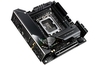
Remember the unusual NVRAM slot we've been seeing on 'Ibex Peak' P55 and H57 boards here at COMPUTEX? Well, we've tracked down Intel and confirmed that the slot is indeed used for Braidwood memory technology - confirming that Braidwood will be made available later this year with the launch of its Core i5 processors, codenamed Lynnfield.
So, what's Braidwood and why does it matter to you? Well, as mentioned previously, it can be thought of as Turbo Memory on steroids and it provides dramatic I/O acceleration to speed up all-round system performance. Think of it as a super-quick cache, acting if you will like a board-mounted SSD to provide rapid access to files and applications.
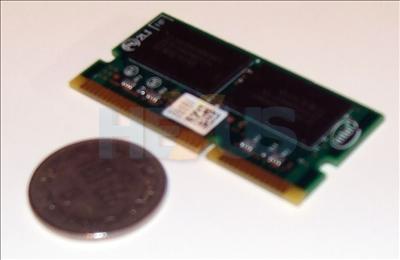
The Braidwood flashy memory module, pictured above, will slot into NVRAM slots found on Intel's Ibex Peak boards - beginning with P55 later this year. Intel isn't yet quoting capacities for its Braidwood modules, but we're led to believe they'll reach up to 16GB in size.
We're looking forward to mainstream Nehalem as much as the next guy, but Braidwood - we reckon - will provide the performance boost most will recognise. SSD-like performance isn't to be sniffed at, and we'd expect Braidwood to make its way into Core i7 boards somewhere down the line, too.

Copyright © 1998 - 2009, HEXUS.net. All rights reserved. Terms, conditions and privacy information.
HEXUS® is a registered trademark of HEXUS Limited.
HEXUS.community :: your right2reply
sounds interesting but yeah price is gunna be an issue. Id be interested to know how it actually caches files, like do you select which ones it caches or does it figure it out automatically.
It'll just use the existing ReadyBoost and SuperFetch features of Vista and Win7 I'd imagine, using a driver to trick the OS.
Price will be an issue for most, but then, I doubt this is aimed at most, it's aimed at the enthusiasts, those who otherwise might have 8gb+ of RAM to take advantage of the SuperFetch goodness. If i5 and i7 were being launched at the same time, I doubt the 'budget' i5 boards would even have seen it, it being filtered down for the next generation instead.Quote
So my 1TB SATA hard drive can now come with a 16GB cache. Wonder how prohibitively expensive this will be, considering that it needs to be *much* faster than a SATA drive to make it worthwhile...
It doesn't need to be faster in sequential speeds, only access latency and random read/write, which co-incidentally suits flash down to the ground. If you've got something large and sequentual then I expect it'd just pass right through.
Think of it as a hybrid SSD/mechanical and it's not far off, using the strengths of both when appropriate.
I/O has long been a bottleneck and I think targeting that will make a big difference to the every day 'feel' and speed of a system.. however it's only a very temporary stop gap until SSDs become mainstream.Quote
It doesn't need to be faster in sequential speeds, only access latency and random read/write, which co-incidentally suits flash down to the ground. If you've got something large and sequentual then I expect it'd just pass right through.
Think of it as a hybrid SSD/mechanical and it's not far off, using the strengths of both when appropriate.
I/O has long been a bottleneck and I think targeting that will make a big difference to the every day 'feel' and speed of a system.. however it's only a very temporary stop gap until SSDs become mainstream.
If having an SSD makes this redundant then surely they'll have to be pretty cheap to be anything like worthwhile otherwise you might as well put the cash towards an SSD insteadQuote
If having an SSD makes this redundant then surely they'll have to be pretty cheap to be anything like worthwhile otherwise you might as well put the cash towards an SSD instead
Correct. But SSDs need a capacity in the hundreds of GB before they will be considered mainstream - this only goes up to 16GB so I think cost will be in their favour (for the same performance).Quote
Reply