


Tick or tock
As the hullabaloo surrounding AMD's transition of its desktop and server chips to a 45nm process draws to a close, Intel is now disclosing details on plans for next-generation 32nm chips, keeping one step ahead of its immediate x86 rival.In a conference call headed by Stephen L Smith - VP, Director of Group Operations for the Digital Enterprise Group - and Mark Bohr - Research Fellow - Intel laid out server and desktop plans emanating from a move to a smaller manufacturing process and introduction of a slightly revised microarchitecture, known as Westmere - the successor to present Nehalem.
Firstly, reiterating remarks made by Intel boss, Paul Otellini, earlier today in Washington, DC, which we covered here, Smith went on to disseminate some relatively juicy morsels on Intel's upcoming activity.
Time is tocking (or is that ticking)
All images courtesy of Intel
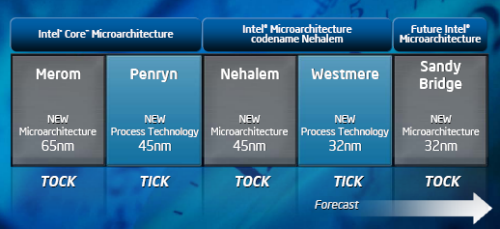
As a recap, Intel is on a self-proclaimed Tick Tock strategy, where a
new architecture is released, dubbed Tock, followed, roughly, a
year later with a slightly enhanced design on a smaller manufacturing
process: the Tick. Then, again a year or so later, the same process
technology is
kept intact but a new architecture is brought up, which brings us back
to the Tock.Present-generation Nehalem is a Tock, and it's to be followed a move down to 32nm and a slight improvement of the architecture with a Tick. That Tick, of course, is Westmere. Got it? Yup? OK.
Now, Intel's architectures are designed with three market segments in mind - server/workstation, desktop , and mobile. Once a Tick or Tock have been established, the architecture is extended to all three segments. Right now, Nehalem is productised in the server (Xeon 5500-series), desktop (Core i7), but previous-generation Core 2 still holds sway on mobile (Penryn).