Published: Tuesday 3rd February, 2009 | Author: Parm Mann
Products: Core i7 975 EE
Companies: Intel (All Intel content)
External reviews: Intel Core i7 975 EE
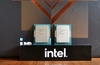
Having raised the performance bar with ease back in November 2008, Intel appears to be set to give it another nudge forward with the launch of the Core i7 975 Extreme Edition processor.
Details are in short supply, but overclockers Mikeguava and Fugger appear to have their hands on Intel's range-topping part and have done what they do best - overclock the hell out of it. Using GIGABYTE's EX58 Extreme mainboard, Corsair's peltier-cooled memory and a pair of Radeon HD 4870 X2 graphics cards, they managed to score a staggering 47,026 3DMarks.
What's interesting is that the CPU features D0 stepping, and such a change usually denotes a refined silicon package that could result in lower power consumption and should provide greater overclocking headroom.
There's no news on release details at this early stage, but this is a chip that's likely to be priced close to the mind-boggling £1,000 mark. We'd hate to be one of those who've recently splashed out over £800 on the soon-to-be-dethroned Core i7 965 Extreme Edition.

Copyright © 1998 - 2010, HEXUS.net. All rights reserved. Terms, conditions and privacy information.
HEXUS® is a registered trademark of HEXUS Limited.
HEXUS.community :: your right2reply
same with Intel, they're known to have very fast and overclockable processors, which means us mere mortals that can only afford the lower end of the market will usually go for the Intel option.
but just by Intel holding that performance crown up at the top end, means that the lower end of the market is also boosted by Intel's reputation.Quote
Why companies insist on pushing out range-topping products and silly high prices at this point is beyond me. I doubt the few sales, even at silly prices, is going to make up for the development and marketing of it.
I'm no expert, but I was under the impression that all chips in the same range/stepping came from the same fab(s) with the same build costs and were simply speed binned. So if some mug will give you 3-4x the price for something that cost you the same amount to make as the low end chip of the range(which will probably do the same speed with 5 mins in the bios), why wouldn't a business sell it?
There's also "the best", syndrome. There are people who want to, or want to say they own the best CPU/watch/car/whatever and are not only prepared to pay for the privilege, but feel they aren't getting the 'best' if they don't pay a large premium over the standard product.Quote
I'm no expert, but I was under the impression that all chips in the same range/stepping came from the same fab(s) with the same build costs and were simply speed binned. So if some mug will give you 3-4x the price for something that cost you the same amount to make as the low end chip of the range(which will probably do the same speed with 5 mins in the bios), why wouldn't a business sell it?
Sure, all the chips share the same die manufacturing, but there's also further circutry modifications required to make the EE packages. Then Intel needs to develop and extensively test the retail EE heatsink. Then there's marketing costs on top of that, pushing out engineering samples to various companies, sample products to hand out to reviewers, etc etc. It's not exactly buttons to push out a new model.Quote
Sure, all the chips share the same die manufacturing, but there's also further circutry modifications required to make the EE packages. Then Intel needs to develop and extensively test the retail EE heatsink. Then there's marketing costs on top of that, pushing out engineering samples to various companies, sample products to hand out to reviewers, etc etc. It's not exactly buttons to push out a new model.
All true, but this all has to be done on low end chips too. Do you think a £800 EE chip cost 4x more to make/market than the 600mhz slower £200 chip? The profit margin is higher and as matty rightly pointed out having the overall performance crown is very good for business in of itself, core 2 being the great example of this in recent times. It boosted share price, sales even in lower market segments where AMD could produce a similarly performing chip in the same price range, not to mention lot of good (often free)PR. Go back a bit further and you have the exact same situation with Athlon and it's thousand pound FX flagship.
These chips have very little point for the average consumer, not even for the enthusiast market. Perhaps even less for enthusiasts, but they make business sense. So long as that holds true they will keep releasing them as often as they feel they can get away with.Quote
Reply