
Published: Friday 18th July, 2008 | Author: Parm Mann
Products: LM10
Companies: Danamics (All Danamics content)
The world's CPUs are getting quicker and smaller, but hotter, too. Whilst processor technology moves forward at an increasingly rapid pace, cooling solutions don't tend to keep up.
That, however, could change if Danamics' LM10 CPU cooler can do what it claims. The LM10 is the world's first commercially available liquid metal based CPU cooler, and promises to be an efficient, reliable and scalable technology base for cooling of high heat flux semiconductors.
Danamics was founded in Denmark back in 2005, and has used metal based cooling solutions for a variety of larger-scale purposes. With the growing need for improved PC-orientated cooling, it has now set its sights upon CPU hot spots and believes its technology to be the answer.
So, how does it all work? Well, the LM10 cooler, pictured below, comprises of two key elements; liquid metal and an electromagnetic pump. The electromagnetic pump has the advantage of no moving parts, and an unlimited mean time between failures. The liquid metal has superior thermo physical properties and can be circulated without moving parts thanks to the electromagnetic pump.
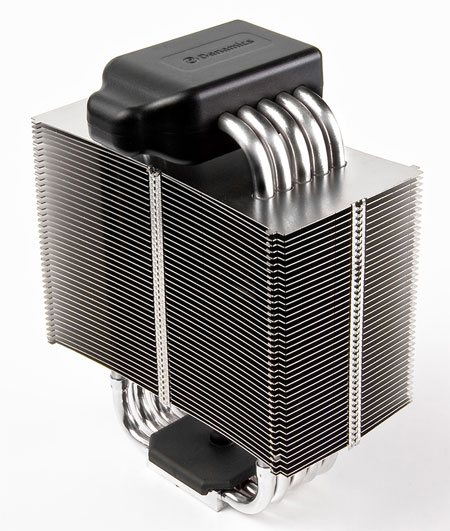
Put it all together and you have what Danamics claims to be a cooler that has the lowest thermal resistance of any air-cooler in the market, and cooling capabilities that exceed most water coolers in a single device. Bold claims, indeed.
There's clearly plenty of advantages over traditional air and water cooling. There's no need for a fan thanks to the electromagnetic pump, and unlike water cooling, there's no need to mount radiators, pumps or other equipment. With no moving parts, noise isn't a factor, either.
It all sounds mighty promising, but we've yet to see any real-world performance figures. Though we must admit, we're itching to put the LM10 to the test. There's also no word on pricing, and that may ultimately decide whether or not this technology moves forward.
Nonetheless, it's interesting stuff and you can read all about it at the official Danamics website.

THGWorldwide.com
Keep track of THG's news and latest events on Twitter!
Copyright © 1998 - 2009, HEXUS.net. All rights reserved. Terms, conditions and privacy information.
HEXUS® is a registered trademark of HEXUS Limited.
HEXUS.community :: your right2reply
Edit: Such alloys typically consist of gallium indium and tin.Quote
I doubt they'd risk being sued for false advertisement. It's quite easy to see how it works also, as the liquid metal reaches a higher temperature, it's viscosity increases and the electromagnetic pump pulls the warmer metal up easier which in turn pushes the cooler metal down.
no, the temperature shouldn't have an effect on the performance of the motor, if it was an open system it might, but as the pipes are sealed any change in temperature will affect the pressure but not the density of the liquid.
the electromagnetic pump just works like an ordinary pump and just circulates the liquid around the circuit continuously, the only difference is that it is using electromagnetic induction -which relies on the liquid conducting electricity- to push the liquidQuote
Could potentially be rubidium, francium, caesium or gallium.
The most stable isotope of Francium has a half life measured in minutes and is a solid at room temperature..
Caesium explodes in when it comes into contact with water and is also a solid.
Rubidium is solid at room temperature and reacts violently with water.
Gallium is also solid at room temperature although it would melt at CPU/HS temps. However its cooling wouldn't be any good until it has all melted.
:rolleyes:Quote
Where is it transfering the heat to? From my understanding the "liquid metal" is just going around in circles keeping the heat within the system?
Yeah, as other replies have said, I think a fan would be needed, which means there are "moving parts". Doesn't that defeat the purpose?
What about cost of this very interesting yet new technology.
Yeah, I'd like to get an answer on that.
Their website's quite primitive. Will wait for Hexus' review on this - that should clear things up.
(Edit: Just seen the last post was a while back. Sorry to "thread-urect".)Quote
Reply