

We know that the 45nm-based Atom shares the same ISA as the Core 2 processor, meaning that any software that runs on the latter - and that amounts to some $100bn-worth in 2007 alone - will also run on the Atom.
Ultra-low-wattage processors need to be able to handle all elements of what's termed the full web experience - Flash-encoded video, for example. The trick is to do all this and still retain low, low platform power figures that are needed for decent battery-life in MIDs and on-the-go netbooks.
Launching five Atom CPUs yesterday, ranging from 800MHz through to 1.86GHz. Out of these, three SKUs, 1.33GHz; 1.6GHz; and 1.86GHz, support hyperthreading and a 533MHz FSB,. The other two, non-hyperthreaded, operate at 800MHz and 1.1GHz and feature a 400MHz FSB. Average power for all but the lowest-clocked part is reckoned to be 220mW (one-fifth of a watt).
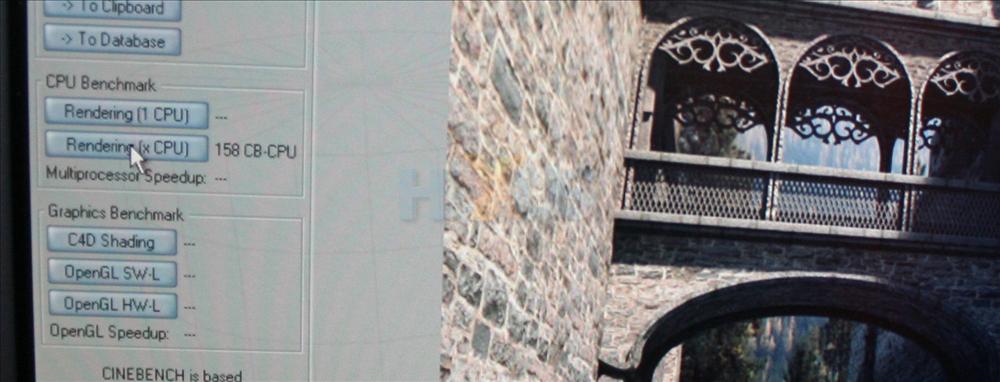
Now, Intel demonstrated the 1.6GHz model, Z530, running CINEBENCH 9.5 with and without hyper-threading enabled. The non-HT CPU returned a benchmark score of 103, and the HT-enabled model one of 158, as shown above. Putting that into some kind of context, an AMD Athlon 64 3000+ benchmarks at 256, and, on the other end of the scale, an Intel Core 2 Extreme QX6700 at 1,327 marks, in a test which is heavily compute-intensive.
Knowing these figures and taking them with due knowledge that platforms can, and do, make a significant difference in performance, the higher-clocked Atoms, designed for netbooks, should provide a reasonably smooth Internet-centric experience, along with enough horsepower for basic day-to-day tasks with Microsoft XP or Linux operating systems.
The MID-oriented Z500 (non-HT, 800MHz clockspeed, 400MHz FSB), sacrifices power for battery-life, but, from what we've seen and taking into account the supporting Poulsbo chipset, offers enough clout for a smooth web and multimedia experience. Trouble is, Intel's $45 pricing for the CPU and chipset will hinder the emergence of the ultra-low-cost MID.